Oil on Canvas!
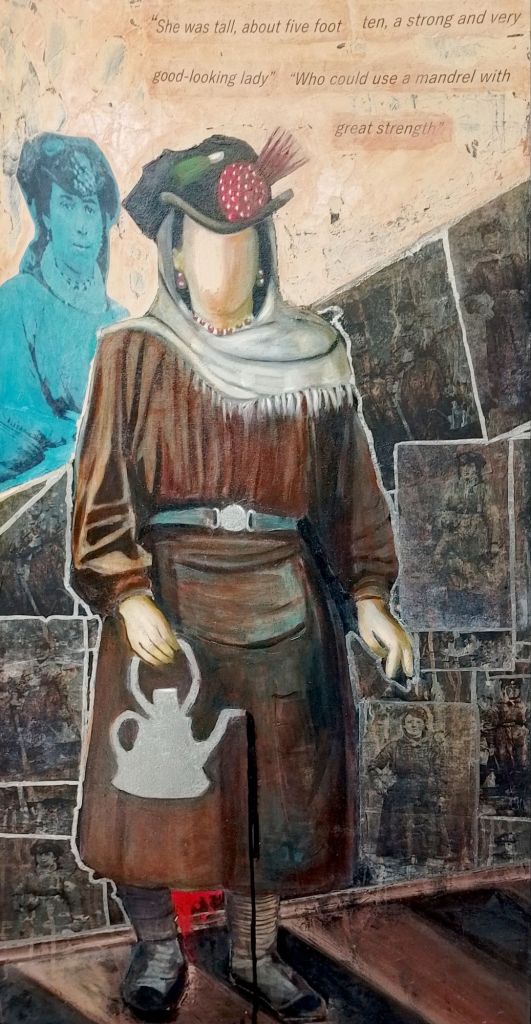
No gold leaf but a hint of tin leaf for the oil can and buckle! Gold Leaf Supplies
I have always been fascinated by the William Clayton collection of photographs of the Tredegar Tip Girls!
As someone who worked in a scrapyard, driving lorries, how women across history worked in what is now seen as a man’s world, has always fascinated me. I was enthralled to read Norena Shopland’s book ‘Women in Welsh Coal Mining’ and visited the Glamorgan Archive for a talk about her findings. More info here
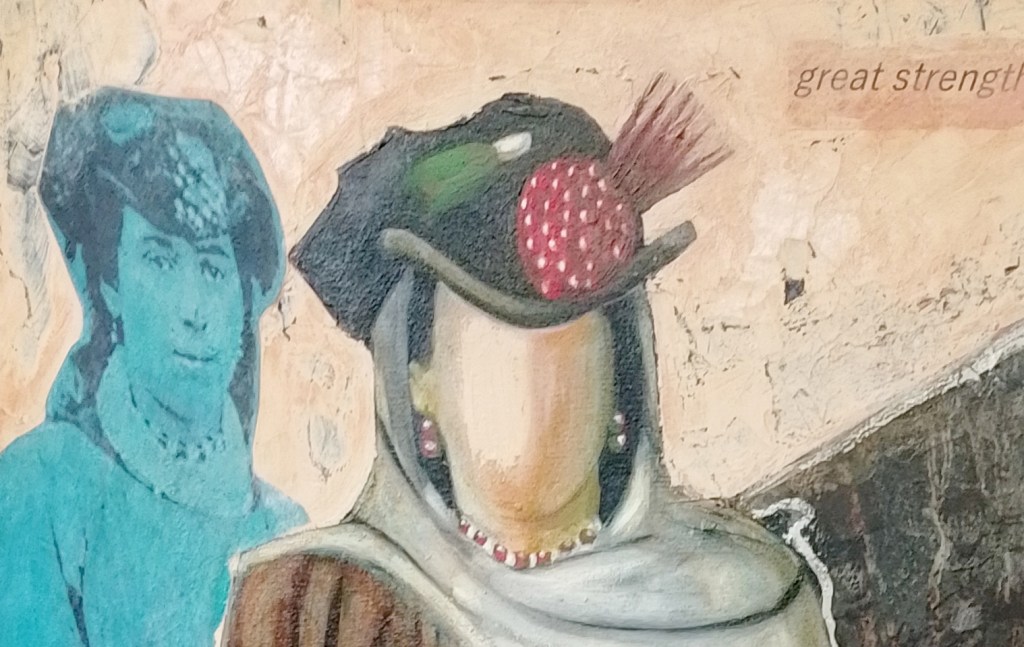
This inspired me to paint this painting, the face is left blank as women’s history so lags that of men’s – so this is for all those women whose names and contributions are lost in time.
Until 1842 women and children had regularly worked underground, however, the Mines and Collieries Act banning women, girls, and boys under 10 from working underground.
This was a blow to many women who earned their living, or supplemented their household income from working underground, these women loved their jobs and campaigned to keep them, and they marched on Westminster twice, in protest, wearing their working costumes!
Tip girls developed a distinctive style of dress, a unique feature of Welsh women, who were very keen to keep their hair covered with a scarf from the coal dust, was decorating their fancy hats with feathers, buttons and bows, a splash of colour!
I often think about these women and girls who worked long shifts in the Welsh coal fields, no sanitary products! No running hot water at home how must they have managed.
The ban was not enforced for many years employers simply ignored the laws but finally, women were moved to the pit brow where they would pull and push the trams of coal, off the pit head, empty it, break up large chunks of coal, clean and pack it ready for sale.
In 1844 when Pembrokeshire suffered its worst mining disaster at Cleddau Bridge killing 40 miners many believed that this included women and children. Some miners on the local memorial are recorded by their surname only, hiding the fact that these were likely women, their identities deliberately hidden.
The Mystery of Esther Phillips
Esther Phillips was described as a “tall, about five foot ten, strong and very good-looking lady”.
She was also recorded as someone “who could use a mandrel with great strength” a mandrel was a short-handled pick favoured by colliery workers at that time.
Esther Phillip’s story is one of the many faceless, and nameless stories of working women across Wales.

 Pethau Bach