Why are Women’s Working Histories Ignored?
“My illustrious lordship, I’ll show you what a woman can do” – Artemisia Gentileschi, (Italian artist 1593-1654)
Introduction
Women have suffered the indignity of being written out of history with the rare exceptions of those female leaders that managed to cut through and capture the general imagination. In Britain, the rights of women and the laws relating to them, have been influenced by the population and societal changes over the last 2000 years. All of which have contributed to the power imbalance of men over women. Working women’s histories have also been tragically ignored. In this essay I offer some examples of how through the medium of art, some women’s stories have been renegotiated and reimagined – stories that would have remained untold if it were not for the creativity of artists. I will demonstrate how telling these stories artistically has become a powerful tool for empowering women and redressing the gender imbalance.
Why have women been ignored?
Bettany Hughes in an interview with English Heritage in 2016 referred to “The inconvenient truth that women have always been 50% of the population, but only occupy around 0.5% of recorded history. Clearly something has gone wrong here, the maths just doesn’t work.”
It seems a strange acceptance or pretence that half the population did nothing worth remembering, and therefore, not surprising, that a survey carried out by English Heritage in March 2016, shows that 40% of respondents stated that “women did not impact history as much as men”
The reasons for this relate to the development of empires across the world, and history being told by those who had the muscular power to fight and win, and who controlled trade: men.
It is largely accepted that women in early history were venerated but it is with the development of state-organised societies we start to see to the stratification of the relationships between men and women. Castrucci argues that the process of colonisation influenced “masculinity, femininity, and national identity while exposing the complexities of lived experience.” She also quotes Dipesh Chakrabarty who argues that “European imperialism reduced humanity to “the figure of the settler-colonial white man”, constructing a heroic masculinity that justified domination while marginalising women and colonised men” (Castrucci, 2025).
The intersection of gender and race has increased the challenges faced by women of colour. Shaw notes Mary Seacole, a Creole nurse and businesswomen in the Crimean war, who was ignored by Florence Nightingale because of her Jamaican roots (Shaw, 2023). In a Welsh context, Betsi Cadwaladr was a Welsh nurse who did work with Florence Nightingale, but they clashed possibly due to their differing background: Cadwaladr was from a working-class background unlike Florence Nightingale who was from an upper-class background.
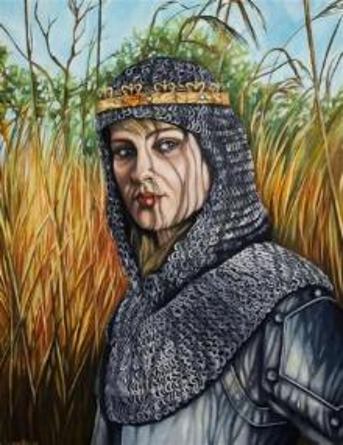
Fig. 1. Gwenllian ferch Gruffydd, Meinir Mathias 2026, Oil on Canvas.
Boudicca is a well-known female leader, but not so well known outside of Wales is the Warrier Queen Gwenllian ferch Gruffydd (c1097–1136) who was a Welsh noblewoman, daughter of Gruffydd ap Cynan, King of Gwynedd, and the wife of Gruffudd ap Rhys, the ruler of Deheubarth. She led the Great Revolt of 1136 but was captured and beheaded at the battle of Kidwelly Castle at the hands of the Norman invaders. She is the only woman known to have led an army in medieval Wales and her name was often invoked by Welsh armies in subsequent years. (Fig.1)
“The history of women’s rights in Wales was not forgotten. It lived on through tales and traditions. And, more recently, the legal rights mediaeval Welsh women had and lost have begun to re-emerge.” (Howells, 2017).
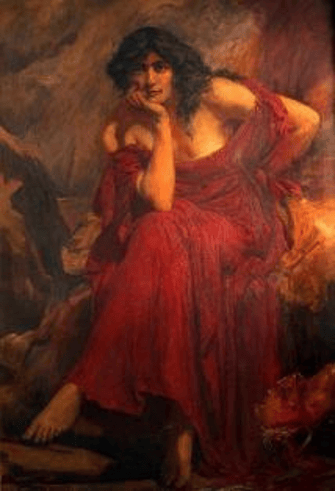
Fig. 2. Ceridwen by Christopher Williams, 1910, Oil on Canvas. Ceridwen in the Mabinogi is a goddess of change and rebirth and transformation, and her cauldron symbolizes knowledge and inspiration
These tales refer to the “Pedair Cainc Y Mabinogi -The Four Branches of the Mabinogi. These are the oldest and most complete mythical prose in Britain, originally ancient oral tales told by the barddau – bards – which give a multi-layer picture of women in medieval Wales. They were written down in the Llyfr Gwyn Rhydderch-White Book of Rhydderch,1350, and the Llyfr Coch Hergest -Red Book of Hergest, 1382–1410 . (Fig.2) The bardic tradition was so rooted in Wales and so highly thought of, according to the Laws of Hywel Dda they were considered a member of the King’s court.
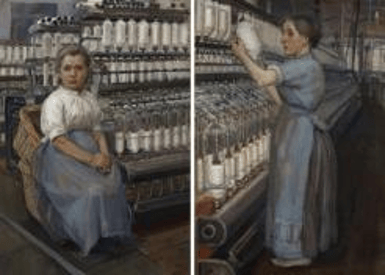
Fig. 3. Sylvia Pankhurst, Leader off the Suffragettes painted these watercolours in Glasgow and Staffordshire in 1907, when she documented the poor conditions and low wages experienced by women. Now in the Tate.
Those women that have been noted in history in modern times are those who were leaders, politicians, the middle and upper classes. When it comes to the working classes and specifically working-class women these are largely forgotten. Historians have argued that “working people produced very little historical evidence that could be used to contribute to our understanding.” (Griffin, 2022) Emma Griffin argues that such evidence does exist in working-class autobiographies of mainly men, but some were written by women such as that of Molly Murphy, a working-class woman who became a suffragette and socialist. However, in art, the working-class have very often been represented through the lens of crisis, poverty, or the workplace. (Fig. 3)
It can be said that working-class women have always worked in agriculture, domestic work, cottage industries, domestic service, nursing, teaching and industry. A study of early English modern work practices “show that women worked in all the major areas of the economy. Of the 62 subcategories of work shown….. women made up the majority of those carrying out work tasks in 27, and less than 10 per cent in only 12.” (Whittle, J. et al, 2025)
Wool, work and women
Transhumance was a key part of upland sites in Wales from early medieval times; it disappeared in south Wales by the 16th century but remained in some areas until the 19th century.(Comeau, R. et al 2021 p113) In the Laws of Hywel Dda men controlled the pigs and women the sheep, and it was the women who moved with the sheep to the highlands in the summer with the children. Sheep were primarily used for their milk and wool.
The evidence of this rural practice is knitted within the landscape in the place names and historic structures that remain – the summer dwelling, hafod (haf– summer, and bod– to be, Hafotai pl).
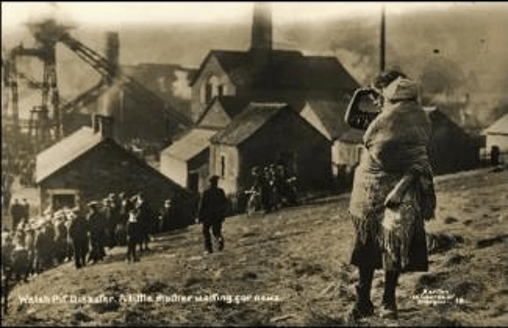
Fig.4 Senghenydd Colliery Disaster 1913, Mother waiting for news.
Woman’s stories have faded and it’s men’s role in the industry that followed which has dominated the narrative of these uplands. Much of those stories which are remembered are through historic photography. The mother is elevated in this photograph. (Fig.4) Whoever took the photograph places her offset but elevated and in prominent focus, her hand raised protecting against the glare of the winter sun. There is no more iconic a symbol of fibre art than the Welsh nursing shawl, a symbol of practicality, culture and craft carrying babies the Welsh way but still allowing the mother to carry on working. This image tells of the importance of women in keeping these communities knitted together even in the most tragic of circumstances. She is looking down at the developing tragedy of the Senghenydd mining disaster on October 14, 1913. This was the worst mining accident in British history, resulting in the deaths of 439 miners, creating many widows and fatherless children.
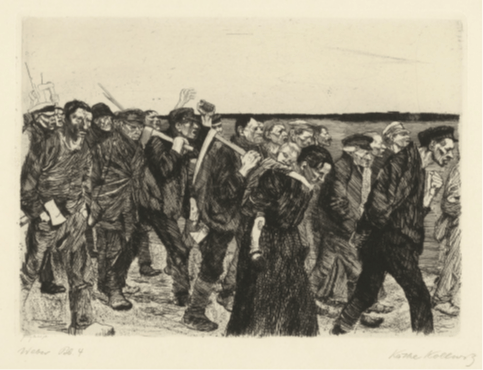
Fig. 5, March of the Weavers, sheet 4 of the cycle “A Weavers’ Revolt”, Käthe Kollwitz, 1893-1897
This placing of a single woman in a prominent position is mirrored in “A Weavers’ Revolt” by Käthe Kollwitz. (Fig. 5) Notably the only woman featured in this piece, marching alongside the revolting weavers, she is bearing a child on her back and prominent in the foreground. Kollwitz wants the viewer to focus on this woman and her child, to remind us of the burden women always carry. The child is asleep, having endured a long journey. A mother, her head bowed, is carrying the burden of a harsh life. Women feature prominently in Kollwitz‘ art, those who bear the brunt of the harsh reality of the working classes.
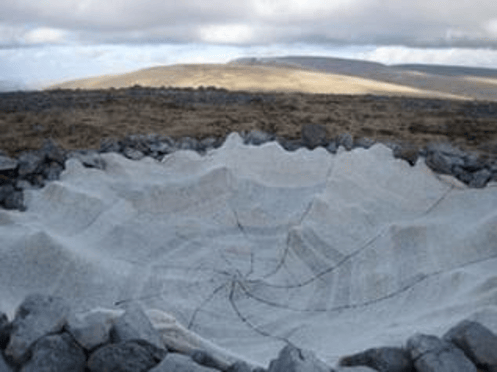
Fig. 6 Cwtch, Ann Jordan, 2010, site specific art installation
Ann Jordan’s collaborative and site-specific art project (Fig.6) focused on the coffin trail, a commemorative trail from Ystradgynlais to Llanddeusant over the Black Mountain, where the bodies of men killed in the coal mines and quarries in the 19th century were carried home for burial. Jordan created a hand knitted 20ft circular blanket named Cwtch from 12 miles of hand spun wool from local sheep, correlating to the length of the coffin trail. This is an example of how history can be renegotiated, bringing together the stories and crafts of both men and women.
Coal, work and women.
The woollen mills in the southwest relied on demand from south Wales coalfields for trade and continued to be successful in south Wales until the end of World War I.
Until 1842 women and children had regularly worked underground, however, the Mines and Collieries Act banned women, girls, and boys under 10 from working underground. This was ignored for several years. A memorial erected in 2002, for a mining accident at Landshipping, Pembrokeshire in 1844, lists seven names which were noted as ‘Miner’. These are believed to be women and children. (Coflein, RCAHMW)
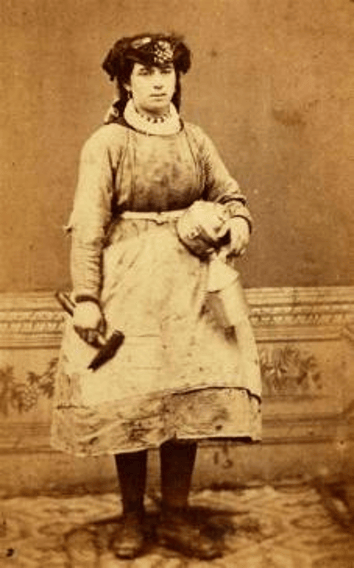
Fig. 7 Tredegar Tip, W. Clayton 1865, photograph.
Women remained working at the pit heads. The 1872 Mines’ Regulation Bill, tried to tighten up the regulations, including an argument whether women had the right to be steam-engine drivers. Norena Shopland notes in her book about women in the mining industry” Conservative MP Henry Liddell (1821-1903) argued the dress women wore was sufficient a reason why they should not be in charge of engines”. (Shopland, 2023, p121).
Tip girls in Wales wore a distinctive style of dress: they were very keen to keep their hair covered with a scarf to protect their hair from the coal dust, and were noted to wear fancy hats with feathers, buttons and bows, a splash of colour! (Fig. 7)
An unknown photographer called William Clayton who worked in Iron Street, Tredegar in the 19th century took a set of 43 photographs of 69 individuals of the Welsh Tip Girls in Tredegar 1865, (one being a Wigan pit brow lass). (Fig. 9). These are now held at the Manchester Art Galleries, bar one image that is held at Amgueddfa Cymru– National Museum Wales. These images at the time generated such interest, that Shopland notes that they became a ‘tourist attraction’(p100), with negative consequences. Sometimes, they did fight back: a Dowlais pit girl wrote to a Welsh Language newspaper Y Glarian, 1867, complaining that the tip girls were not afforded the same reference as ‘ladies’ as other groups of women. She wrote
“We are not any worse than the ‘girls’ who stay at home, and if you want a readership for your paper you had better shut up about the colliers, the furnace men and about us, the tip girls” (Shopland, p101).
The 1911 Coal Mines Act again tried to stop the employment of women in the mining industry, but this only lasted until the outbreak of WW1. This was a blow to many women from across England and Wales who earned their living in the industry. These women loved their jobs and campaigned to keep them, and they marched on Westminster twice, in protest, wearing their working costumes!
It could be argued that little would be known of the role of women in the mining and iron industries, if it were not for this set of photographs. Because of these, their story is now being told in exhibitions, news articles and included in learning resources at some of Wales’ National Museums.
Conclusion
Art is clearly a way of teaching people about history and keeping stories alive, especially important in raising the profile of women, and going forward a way to tell those untold stories of women. Those spaces that have become in modern times, places of men, can be ‘renegotiated’ making room for women’s voices and stories. Art can be used to tell stories of the lived experiences of both men and women from the past, the present and influence the possible for tomorrow.
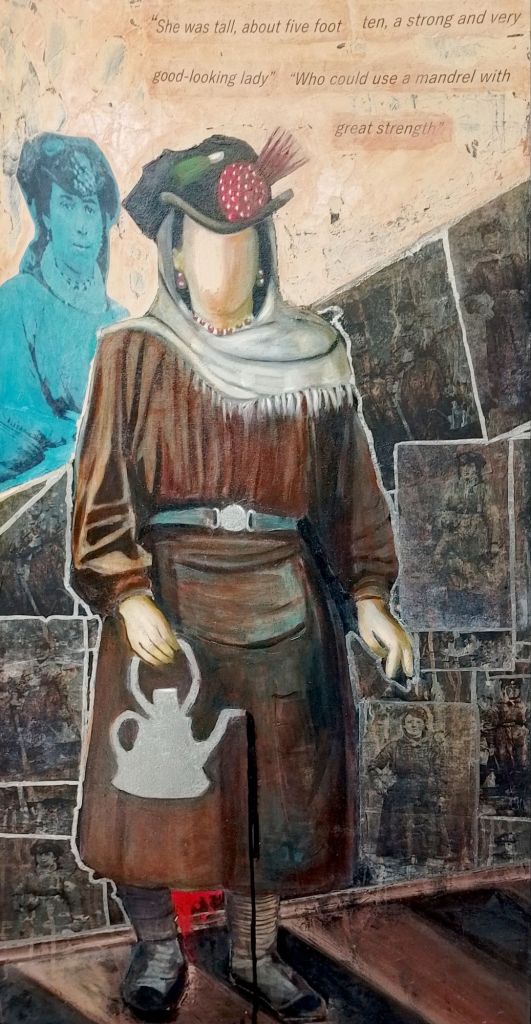
Oil, tin leaf and image transfer; my interpretation of the Tredegar Tip Girls.
Bibliography
Brown, J., (2025) ‘Social Cohesion in Education: The Benefits of Embedding Art and Design in a Learning Environment’, IAFOR International Conference on Arts & Humanities, Hawaii, The International Academic Forum, 2025.
Available at: https://papers.iafor.org/submission89820/ (Accessed: 2 April 2026).
Castrucci, A., “Rethinking a Contested Analytical Lens: The Evolution of Gender in Imperial Historiography” Retrospect Journal, 2025.
Available at: https://retrospectjournal.com/2025/02/23/rethinking-a-contested-analytical-lens-the-evolution-of-gender-in-imperial-historiography/ (Accessed: 2 May 2026)
Collet, P., ‘A Commentary on Women Creating Spaces in Welsh Visual Culture’, Visual Culture & Gender, Vol.3, 2008
Available at: https://vcg.emitto.net/index.php/vcg (Accessed: 2 April 2026).
Comeau, R., and Silvester, B., “Transhumant settlement in medieval Wales: the hafod”, in eds. Dixon, Piers, and Theune, Claudia, Seasonal Settlement in the Medieval and Early Modern Countryside, Sidestone Press, 2021, pp113-125.
Available at: https://www.academia.edu/58788709/Seasonal_settlement_in_the_medieval_and_early_modern_countryside_introduction (Accessed: 3 April 2026).
Garden Pit, Landshipping Colliery, Site Record NPRN 401345, Royal Commission on the Ancient and Historic Monuments of Wales (RCAHMW), 2012.
Available at: https://coflein.gov.uk/en/sites/401345 (Accessed 4 May 2026)
Griffin E., Writing about Life Writing: Women, Autobiography and the British Industrial Revolution. Transactions of the Royal Historical Society, 2022:32: pp5-23.
Available at: https://www.cambridge.org/core/journals/transactions-of-the-royal-historical-society/article/writing-about-life-writing-women-autobiography-and-the-british-industrial-revolution/761231FE8BD645059608F1D87CEBC7C2 (Accessed:02/05/2026)
Hessel, K., ‘A Room of One’s Own: Self-Portrait’ in The Story of Art without Men. London: Hutchinson Heinemann, 2022
Howells, C., “Cyfraith Hywel (the laws of Hywel Dda)” Women’s Legal Landmarks, University of Kent, 2017
Available at: https://womenslegallandmarks.com/2017/08/08/the-laws-of-hywel-dda-c-950/ (Accessed: 2 April 2026).
Howells, C., ‘Cyfraith Hywel (The Laws of Hywel Dda), c. 940’, in eds. Rackley, Erika and Auchmuty, Rosemary, Women’s Legal Landmarks: Celebrating the History of Women and Law in the UK and Ireland, 2018, pp. 25–31.
Hughes, B., “Why were women written out of history? English Heritage, 2016
Available at: https://www.english-heritage.org.uk/visit/inspire-me/blog/blog-posts/why-were-women-written-out-of-history-an-interview-with-bettany-hughes/ (Accessed: 2 May 2026)
Jordan, A., Cwtch-Black Mountain Project, 2010. Available at: http://www.annjordan-art.co.uk/cwtch.html (Accessed: 8 April 2026).
Shaw, I., “Forgotten Women in History” Retrospect Journal, 2023
Available at: https://retrospectjournal.com/2023/03/26/forgotten-women-in-history/ (Accessed: 2 May 2026)
Shopland, N., “Women in Welsh Coal Mining, Tip Girls at Work in a Men’s World”, Pen & Sword History, 2023.
The traditional Welsh nursing shawl, The Free Library, 2020. Available at https://www.thefreelibrary.com/The traditional Welsh nursing shawl.-a0635178139 (Accessed 4 May 2026)
Whittle, J., Hailwood, M., Robb, H., Aucoin, T., Uncovering the World of Work. In: The Experience of Work in Early Modern England. Cambridge Studies in Economic History – Second Series. Cambridge University Press, 2025: pp25-57.
Available at: https://www.cambridge.org/core/books/experience-of-work-in-early-modern england/conclusion/D695ECACBE5C3CB7E1DB2748368E6D60 (Accessed 4 May 2026) http://vipauk.org/enter/muse/wa/c44.html


